
IPB University and USFS-IP Explore the Potential of Technology-Based Forest Areas
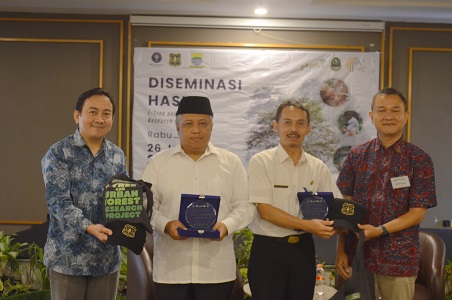
IPB University together with the United States Forest Service-International Program (USFS-IP) collaborated with the West Java Provincial Forestry Service (Dishut Jabar) and the Bandung City Housing and Settlement Area Office (DPKP) in conducting the i-Tree and Urban Forest Research Project in West Java. This research collaboration aims to determine the potential value of urban forest landscapes and predict the condition and value of urban forest benefits in the future.
Dr Kaswanto as the chief of the research team and IPB University lecturer from the Department of Landscape Architecture, Faculty of Agriculture said, this research is an initiative of IPB University and USFS-IP which hopes to help policy makers in managing urban forest landscapes based on research and technology.
Based on the research results, recommendations are also made that can be applied by policy makers. “Measurement of structure, function and dynamics in the urban forest landscape is needed as a basis for sustainable management. i-Tree can be a tool to help managers in making urban forest landscape service management policies because it meets measurement standards and scientific principles,” said Dr Kaswanto.
“This research involves IPB University students as part of the initiation to launch the i-Tree Youth Community, because young people are the future owners and will act as managers of urban forest landscape services in the coming years,” concluded Dr Kaswanto when asked about future expectations from this research activity.
Furthermore, Amarizni Mosyaftiani and Indria Zhafirah as the research team explained how to use i-Tree. Both also explained the results of the research as a sample location conducted in three urban forest landscapes or forest/green open space areas (Djuanda Grand Forest Park, Babakan Siliwangi Urban Forest and Bandung City Maluku Park). The three landscapes serve as models of application that can be learnt in the future. The team also presented the results of the prediction of the condition and value of benefits in the three areas.
Prof Iskandar Z Siregar, Vice Rector of IPB University for Global Connectivity, Collaboration and Alumni Relations said that through this collaboration, IPB University will always support urban forest management in Bandung Regency and City.
Full support also came from Dr Eva Anggraeni, Director of Global Connectivity (DKG) IPB University. She stated that urban forests have tremendous potential for environmental services and should be managed properly. Similarly, Leon Miller, as USFS Programme Manager, said that urban forests must always be managed sustainably, one of which can apply i-Tree technology.
“We must support this technology, because it can be a foundation for us to approach the calculation of the value of forest areas with potential economic and carbon values,” said Dodit Ardian Pancapana, Chairman of West Java Forest Service at the Dissemination of i-Tree and Urban Forest Research Project Results at the Grand Preanger Hotel, some time ago.
DPKP Bandung City also welcomes this research. Dwi Priyono, Chairman of the Park Development Section of DPKP Bandung City said, “i-Tree is something new and useful for managing forest areas and urban parks in Bandung City.”
The USFS-IP, represented by Harityas Wiyoga as In-Country Coordinator in Indonesia, also added, “i-Tree can be utilised by various parties in improving the management of urban forest areas in Indonesia to achieve optimal landscape service benefits.”
Also present at the event were researchers from Bandung, namely Dr Moh Zaini Dahlan and Drs Djuandi from Bandung Institute of Technology (ITB), Dr Fitri Rahmafitria from Universitas Pendidikan Indonesia (UPI) and staff from Dishut Jabar and DPKP Bandung City. (*/Rz) (IAAS/RUM)

