The Center for Mine Reclamation Studies of IPB University Collaborates with the German Government
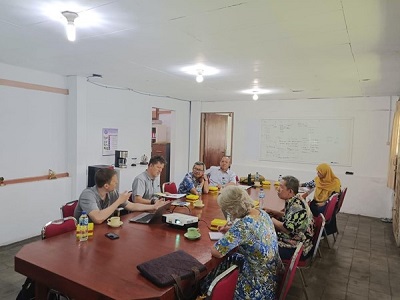
IPB University’s Mine Reclamation Study Center (Pusdi Reklatam) continues to collaborate with the Bundesanstalt für Geowissenschaften und Rohstoffe (BGR), Germany. Cooperation between the two parties existed before the COVID-19 pandemic.
Bundesanstalt für Geowissenschaften und Rohstoffe, in Indonesian means the Federal Institute for Geosciences and Natural Resources, a German government institution that is very concerned with preserving natural resources, especially in mining areas. BGR has initiated a collaboration with Pusdi Reklatam for research, making guidelines for the reclamation of former tin mines and designing demonstration plots on Bangka Island in 2017 and 2018.
In the discussion between the team from BGR led by Mr Philip Schütte, he explained the results of research collaboration and reclamation of ex-tin mining land on Bangka Island in 2019. Mr Philip explained the problems that are still being faced when reviewing the results of reclamation for food crops and forestry plants on land formerly tin mine in Bangka.
“Farmers that are participating in the food crop development program are less enthusiastic as farmers because they are actually more likely to be a miner. Mining tin is believed to be more secure for their lives. Meanwhile, for the reclamation of mining land with forestry plants, the growth results are very good. However, it is still often damaged by the community because the land is mined again,” he explained.
On that occasion, the Chief of Pusdi Reklatam IPB University, Dr Suwardi explained the technique of reclamation of former nickel and coal mining land which is being researched and carried out. In nickel mines, for plants that are difficult to grow on ex-mining land, planting holes are prepared filled with artificial soil made from a mixture of topsoil and compost. Then the planted plant seeds are taken from forest plants that are already growing on the land to be mined next.
“For coal mines, the challenges faced are besides the acid soil, acid mine drainage is often produced. Arrangement of acid soils must consider soil materials that have the potential to produce acid mine drainage. The material is buried in the ground and the soil surface is immediately covered with cover crops and fast growing plants are immediately planted on it. To handle toxic acid mine drainage, it needs to be precipitated in several stages and treated with lime, zeolite and others until the water is ready to be distributed to public waters,” he explained.
“Pusdi Reklatam IPB University and BGR have agreed to continue research collaboration on reclamation of former nickel and coal mining land. The results of the research will be discussed in depth with other researchers and leaders of mining companies. So, the results can be applied to accelerate and increase the success rate of reclamation of nickel and coal mines in Indonesia,” Dr Suwardi concluded.
During the discussion, Mr Philip Schütte was also accompanied by the BGR team including Mr Wolfgang and Mrs Heidi Feldt. Meanwhile, the Pusdi Reklatam IPB University team consisted of Prof Sri Wilarso Budi R, Dr Iskandar and Dr Dyah Tjahyandari Suryaningtyas. (*/Rz) (IAAS/Hap)