
IPB Primate Research Center Introduced Two Forest Conservation Experts from U.S.A. and Canada
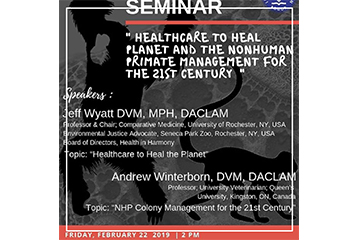
Jeff Wyatt, DVM, MPH, DACLAM—a forest conservation expert from the University of Rochester, New York, USA, focused his latest works to overcome poverty and improve health and well-being of communities around forest in Sukadana village located near Gunung Palung National Park, West Kalimantan, Indonesia. Jeff currently serves as Head of Comparative Medicine Section, University of Rochester, New York, USA and Environmental Justice Advocate at Rochester’s Seneca Park Zoo. During “Healthcare to Heal Planet and Nonhuman Primate Management for 21st Century” seminar held by Primate Research Center, Institute for Research and Community Service,Bogor Agricultural University (IPB) at IPB Baranangsiang Campus, Bogor on February 22nd, 2019, Jeff shared his excellent expertise. It is expected that by increasing the welfare of the community, the forest will survive and have an impact on preserving orangutans because their habitat will not be damaged by illegal logging. Forest loss has adverse effects such as reduced clean water, increased diseases (i.e. malaria and diarrhea), air pollution and global warming. People who live around the forest must be educated about how to protect forests and biodiversity in their surroundings. People’s willingness in forest preservation will be boosted if there are economic activities that can support their daily lives. Since 2007, through the Alam Sehat Lestari Non-Governmental Organization, the community was introduced to organic farming, sheep farming, and community health programs resulting in less penetration to the forest. Instead, they will participate in replanting the forest with durian trees and some most favored food sources for orangutans. Improving the welfare of citizens has a good impact on improving health with reduced disease, infant and under-five mortality. So, this program will provide results in the form of increased welfare of the people around the forest, improved health, reforesting illegal logging areas and saving the preservation of Bornean orangutans. Besides Jeff, there was also Andrew Winterborn, DVM, DACLAM—veterinarian at Queens University (Canada) who delivered the topic of “Captive Management of Nonhuman Primate”, namely the principles of animal welfare in primate animal breeding and the importance of environmental enrichment programs to meet the basic needs of animals. Andrew focused on aspects of the use of a variety of retention equipment and facilities to improve animal welfare and refinement of blood collection procedures to make them less invasive and reduce animal distress. According to Dr. drh. Huda Darusman—Head of IPB Primate Research Center, the two experts are active in an organization called Health in Harmony which is a non-governmental organization in the United States that organizes natural conservation and revitalization programs with integrated approaches in several countries, including Indonesia, since 2007. They succeeded in providing welfare to the community by diverting the profession from the behavior of illegal logging to farming so that conservation could be achieved and the primate animals saved. IPB will continue to establish stronger reinforcement of potential joint projects between two institutions.

