Indonesian Society Is Lacking in Fruits and Vegetable Consumption
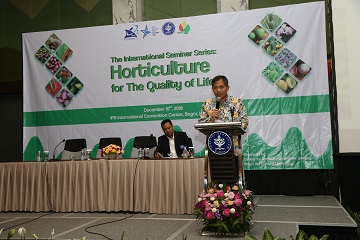
Prof. Slamet Susanto, Head of Indonesia Horticulture Association (PERHORTI) Period 2017-2021 said that based on Health Research and Development Agency (Balitbangkes) 2016, Indonesian people consumption is still dominated by cereals and tubers. The number reaches 300 tons per year, meanwhile, fruits and vegetable consumption are still below 100 tons per year. “In contrast to Indonesia, Singaporean fruit consumption is above 300 tons per year. Of course, this condition can affect public health and the diseases that are caused, including stroke, heart disease, diabetes, and other degenerative diseases,” said Prof. Slamet in the International Seminar “Horticulture for The Quality of Life”, Monday (10/12), in IPB International Convention Center, Bogor.
Additionally, Prof. Slamet also conveyed that life expectancy of Indonesian is 70,1 year. This number is low compared to Malaysia (74,9 year), Thailand (74,3 year), Singapore (82,2 year), and Japan (87,2 year). “This happens because we consume more carbohydrate, fat, and fewer vegetables and fruits. It affects negatively to our health. Horticultural products give many benefits for the health of Indonesians,” said Prof. Slamet.
According to Prof. Slamet, the problem is also influenced by the income of capita that is still below Malaysia, Thailand, and Singapore. Therefore, income per capita must increase to elevate the society’s purchasing power towards horticultural products. “We need a strategy to improve the productivity and quality of horticultural products, increase fruits and vegetable consumption. We also need to raise society’s awareness, synergize research and its utilization, empower farmers in horticulture centers, support the facility and infrastructure, develop the system, data accuracy, and information, also make efficient market system.”
Meanwhile, Dr. Awang Maharijaya, The Head of Tropical Horticulture Assessment Center, Institute of Research And Community Empowerment (LPPM IPB), conveyed the importance of society’s awareness towards the benefit of food quality for a better life. Dr. Awang explained many horticulture roles besides consumption. “Horticulture roles are important to increase income, open job opportunity and increase national GDP. Not only that, horticulture is also beneficial for the betterment of environment and city’s aesthetics,” said Dr. Awang.
In this event that was attended by academicians, researchers, horticulturist, and policymakers, there was a Memorandum of Understanding (MoU) signing between PERHOTI, PKHT IPB, and Japanese Society for Horticultural Sciences (JSHS). Prof. Slamet Susanto, Dr. Awang Maharijaya, President of JSHS, Prof. Sanesuki Kawabata, and Prof. Masayoshi from Yamaguchi University, Japan, signed the MoU.
Also present were the presenter from University of Tokyo, Saneyuki Kawabata and Motoyuki Ishimori, Prof. Sobir (Vice President of SABRAO), Prof. Ming-Tsair Chan from Academia Sinica Agricultural Biotechnology Research, Taiwan, Mr. Thunya Taychasinpitak from Royal Project Foundation, Kasetsart University, Thailand, and Mr. Rahmansyah Dermawan from Shandong Academy and Agricultural Sciences, China.